












Enterprise infrastructure is expanding faster than ever before. But while most enterprises invest heavily in deploying technology, far fewer have institutional control over what happens when that technology exits active use.
At Blackgold, enterprise circularity is viewed as an extension of institutional governance. As digital infrastructure expands, organisations will increasingly be evaluated by how responsibly it is managed once operational life concludes.
“In mature circular systems, accountability does not end at usage. It extends across the full lifecycle of infrastructure itself.”
This transition connects security, circularity, compliance, governance, and enterprise resilience into a unified downstream framework.
Certified data destruction and
secure chain-of-custody at
every transition.
Authorised downstream
recovery aligned with circular
economy frameworks.
Audit-ready documentation
satisfying regulatory and
enterprise governance.
Institutional control frameworks
extending accountability
beyond active use.
Enterprise devices are often treated as depreciating assets. In reality, they remain concentrated repositories of sensitive enterprise information, embedded material value, regulatory accountability, and recoverable infrastructure components.
The challenge is maintaining institutional control as assets move beyond operational environments. This is the role modern ITAD increasingly plays — as a governance layer connecting security, traceability, circular recovery, and enterprise continuity.
End-to-end traceability from asset collection through downstream processing, with
documented accountability at each handoff.
Real-time visibility over asset movement ensuring no device enters uncontrolled downstream channels.
Structured evaluation of each asset’s condition, value, and optimal recovery or resale pathway.
Verified recovery channels that meet regulatory requirements and provide audit-ready accountability.
Compliance documentation and reporting infrastructure
capable of withstanding enterprise-level governance review.
In mature enterprise environments, data governance does not conclude when a device is retired. Secure destruction frameworks must support operational confidentiality, regulatory defensibility, traceable destruction pathways, and enterprise-grade accountability.
Disposal without governance is increasingly viewed as systemic exposure across financial systems, global enterprise environments, telecom infrastructure, and data-intensive industries.
Regulated data environments with stringent destruction and compliance obligations.
Multi-jurisdiction operations requiring consistent, certified destruction standards.
Network-connected equipment
handling sensitive operational and customer data.
Government and institutional ecosystems with heightened accountability requirements.
Healthcare, technology, legal, and analytics environments where data residue creates measurable risk.
Most enterprises can account for assets during deployment. Far fewer possess visibility once those assets enter downstream recovery ecosystems. This creates one of the largest blind spots in modern circular systems.
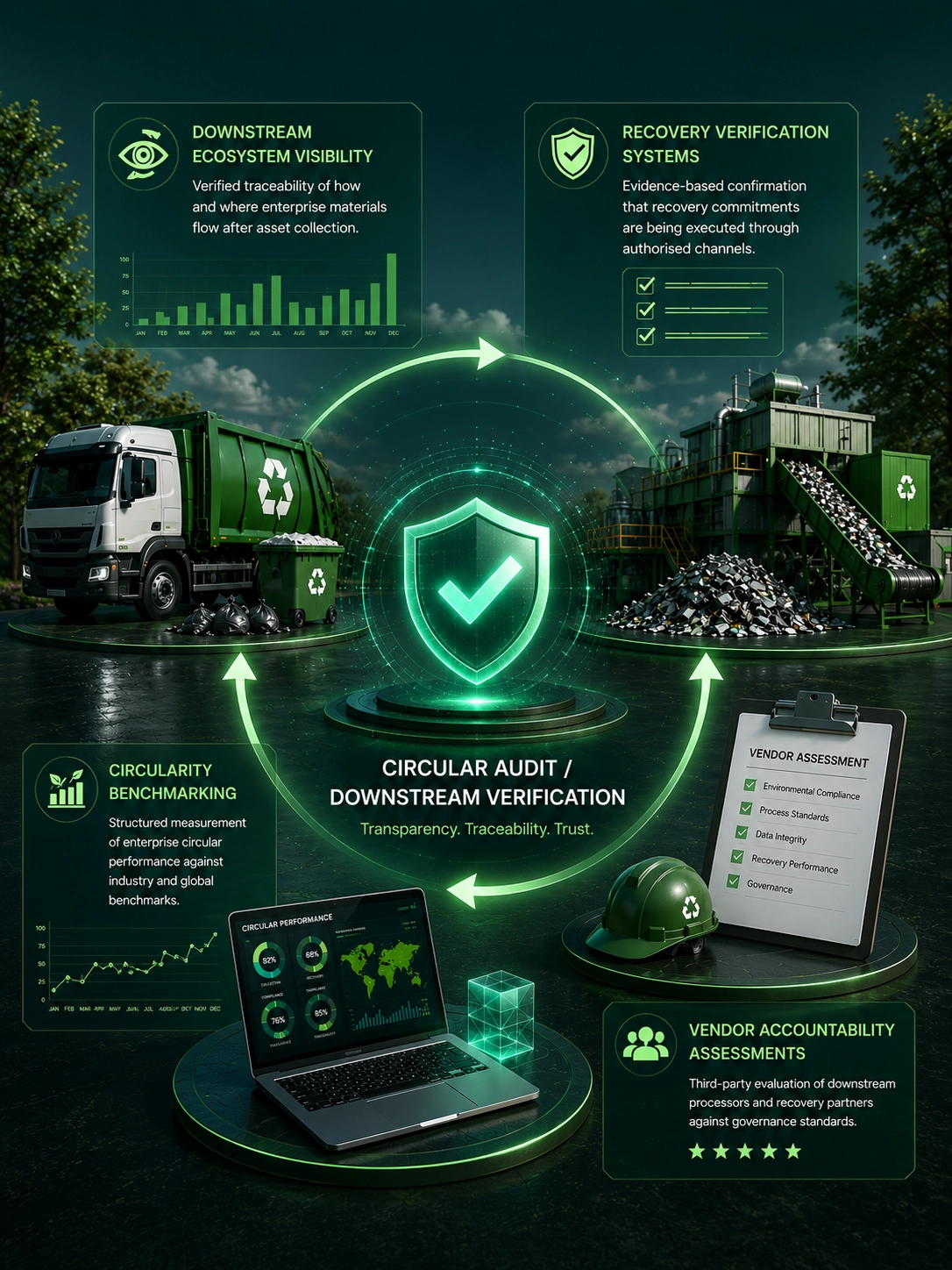
As circular frameworks mature, organisations increasingly require downstream ecosystem visibility, recovery verification systems, and audit-grade environmental governance to satisfy regulatory, procurement, and ESG expectations.

Verified traceability of how and where enterprise materials flow after asset collection.

Evidence-based confirmation that recovery commitments are being executed through authorised channels.

Third-party evaluation of downstream processors and recovery partners against governance standards.

Structured measurement of enterprise circular performance against industry and regulatory baselines.

Documentation infrastructure capable of satisfying regulatory, ESG, and procurement scrutiny.
Core questions about enterprise technology governance, secure asset disposition, data destruction, and how Blackgold approaches structured downstream accountability for corporate organisations.
Once technology exits active use, it doesn’t disappear; it moves into a downstream ecosystem that still carries data, compliance, and material accountability. BlackGold addresses this through a unified downstream framework spanning security, circularity, compliance, and governance, so that risk is managed with institutional control rather than surfacing only when an audit forces the question.
Fragmented, location-by-location disposal makes it nearly impossible to maintain consistent chain-of-custody or accountability. A structured program brings collection, tracking, and processing under one governance framework, so assets from every site move through the same controlled, documented pathway.
Blackgold’s IT Asset Disposition (ITAD) service covers the full asset lifecycle: controlled chain-of-custody from collection, secure data destruction, technical grading, and routing into either certified data destruction or authorized resale with complete documentation and serial-level traceability on every asset. Every device is tracked and certified through a fully auditable chain of custody, with data destruction carried out under documented, certified protocols at each stage.
Enterprise devices aren’t just depreciating liabilities they carry embedded material value and, in many cases, refurbishment or resale potential depending on condition. A proper lifecycle assessment sorts assets into the right recovery pathway rather than sending everything down the same disposal route by default.
Most enterprises can track assets during deployment but lose visibility the moment those assets enter downstream recovery channels which is one of the biggest blind spots in corporate asset management. Real-time tracking and reconciliation close that gap, so there’s a documented answer to where materials went and who processed them.
Audit-ready documentation and verified recovery channels give procurement and compliance teams evidence they can actually stand behind, rather than a vague assurance that “it was recycled somewhere.” That level of traceability is increasingly what regulators, auditors, and ESG frameworks expect enterprises to produce.
Accountability doesn’t stop at the point of usage in markets that scrutinize circular performance, gaps in downstream visibility tend to surface eventually, whether through an audit, a vendor failure, or a compliance review. Treating asset retirement as part of institutional governance, not an afterthought, is what keeps that gap from becoming a liability.