Vertical — Materials & Resources

Critical Mineral Extraction

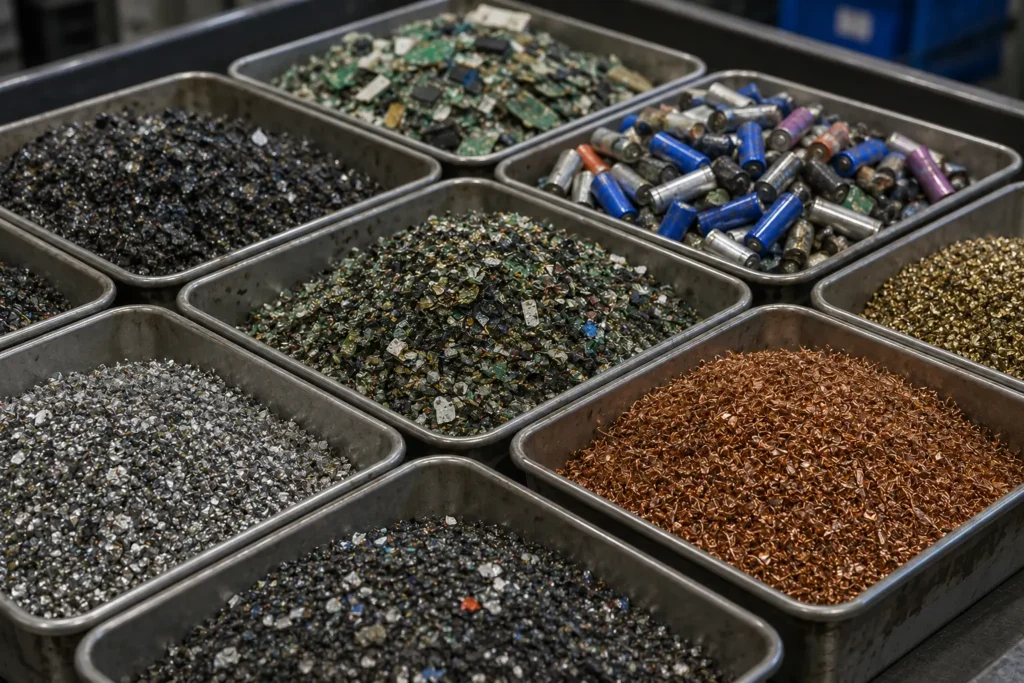
The global economy is entering a materially constrained phase. Lithium, cobalt, nickel, and rare earths are no longer just commodities — they are system-enabling materials. Blackgold is building the recovery infrastructure to keep them in circulation.

Purity standard achieved
0 %
Critical minerals recovered
0 +
Higher concentration vs. primary ore (avg.)
0 x
Landfill routing of recovered material
0

BlackGold's Perspective

Materials as Persistent Assets

At Blackgold, critical minerals are understood as persistent
assets within industrial systems — not consumed inputs. Their
value is not defined at the point of extraction, but across their
entire lifecycle.

Within this view, recovery is not an extension of waste
management. It is part of a broader, structural shift toward
continuous material circulation — where the same atoms
serve industrial systems across multiple generations of use.

As material flows evolve, the ability to retain, recover, and
reintegrate critical inputs will increasingly define industrial
resilience for manufacturers, energy systems, and economies
alike.

Recovery is not an extension of waste management.
It is part of a shift toward continuous material circulation.

The Structural Shift

From Passive Inputs to Active Constraints

Supply characteristics and demand acceleration have converged to create a structural shift in how critical minerals function within global industrial systems.

Supply Characteristics

Concentrated Geology

Critical mineral deposits are unevenly distributed — high-grade reserves exist in a small number of geographies, creating natural concentration risk.

Geopolitical Clustering

Supply chains for cobalt, lithium, and rare earths are concentrated among a handful of producing nations, introducing persistent geopolitical exposure.

Long Development Cycles

New mining capacity takes 10–20 years to reach production — meaning primary supply cannot respond dynamically to demand surges.

Demand Acceleration

Electric Mobility

Global EV adoption is scaling rapidly — each battery pack requires significant quantities of lithium, cobalt, nickel, and graphite.

Grid-Scale Energy Storage

Renewable energy integration demands stationary storage at unprecedented scale, multiplying critical mineral requirements across power systems.

Digital & Electronic Infrastructure

Consumer electronics, semiconductor systems, and industrial equipment embed critical minerals across billions of devices and components.

Materials are no longer passive inputs to industrial systems. They are active constraints — and the ability to manage them across their lifecycle, not just at their point of origin, is becoming a strategic capability.

4× demand growth projected for lithium by 2040 under accelerated transition scenarios

6 countries control over 80% of global cobalt supply — structural concentration risk

Rethinking Extraction

Two Parallel States of Supply

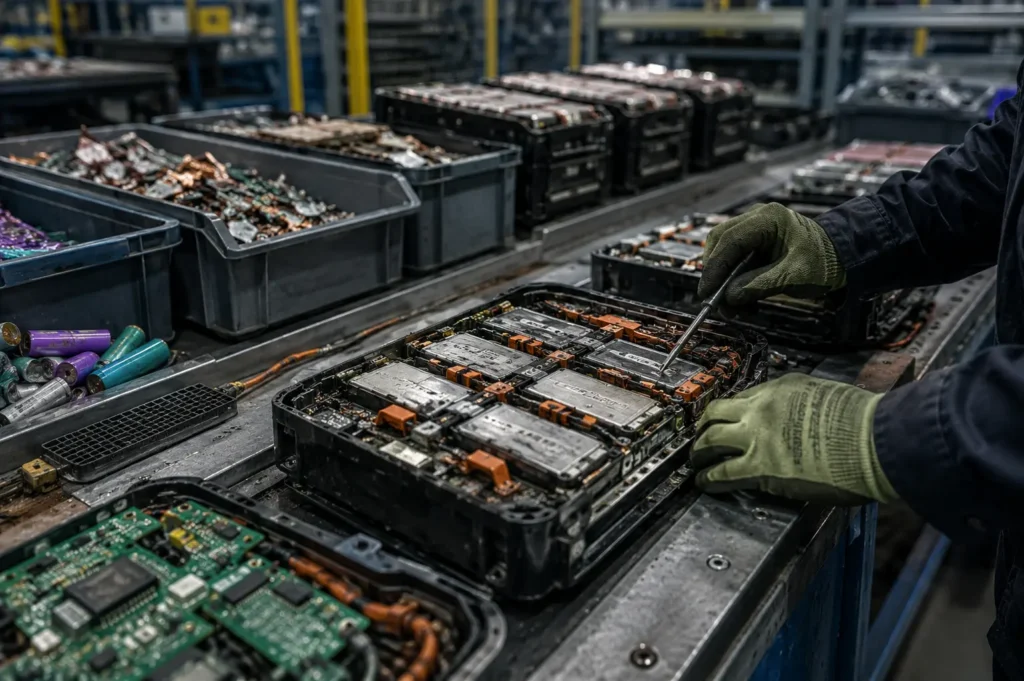
Extraction has historically been understood as a function of mining. That definition is becoming incomplete. Today, critical minerals exist in two parallel states — and the second is growing faster than the first.

End-of-life products now represent a growing, concentrated, and increasingly accessible material base. This reframes extraction itself — not as a point of origin, but as a process of recovery.

State 01

In the Ground

Primary geological reserves — finite, geopolitically concentrated, with long development cycles and high capital requirements to access.

State 02

In Circulation

Embedded within batteries, electronics, and industrial systems — a growing, recoverable pool that expands with every generation of technology deployed.

The implication is fundamental: extraction is no longer solely a geological activity. It is an industrial capability – one that can be engineered, scaled, and continuously improved.

The Emergence of Secondary Supply

A New Layer of Supply Is Forming

As first-generation energy and electronics systems mature, critical minerals are accumulating across three primary source categories — each recoverable, each growing.

End-of-Life Batteries

Lithium-ion battery packs from EVs, consumer electronics, and stationary storage systems — reaching end-of-life in growing volumes as first-generation deployments mature.

Electronic Equipment

Consumer and industrial electronics across smartphones, servers, and infrastructure — collectively embedding significant quantities of recoverable critical minerals.

Manufacturing Scrap & Residues

Process scrap and production residues generated during battery, semiconductor, and electronics manufacturing — often high- concentration and consistent in composition.

Higher Concentration

End-of-life products often contain critical minerals at higher concentrations than the natural ores from which they were originally extracted.

Reduced Energy Intensity

Recovery from secondary sources typically requires significantly less energy per unit of material than primary mining and refining operations.

Greater Proximity

Secondary material sources are located near consumption centres — reducing logistics costs and supply chain complexity versus geologically remote primary sources.

The Supply Implication

Primary

Geological

Mined from earth — finite, concentrated, long-cycle

Secondary

Recovered

Extracted from circulation — renewable, expanding, proximate

Supply is no longer singular. It is dual-layered — and the second layer is the one that grows.

What We Recover

Four Critical
System-Enabling
Materials

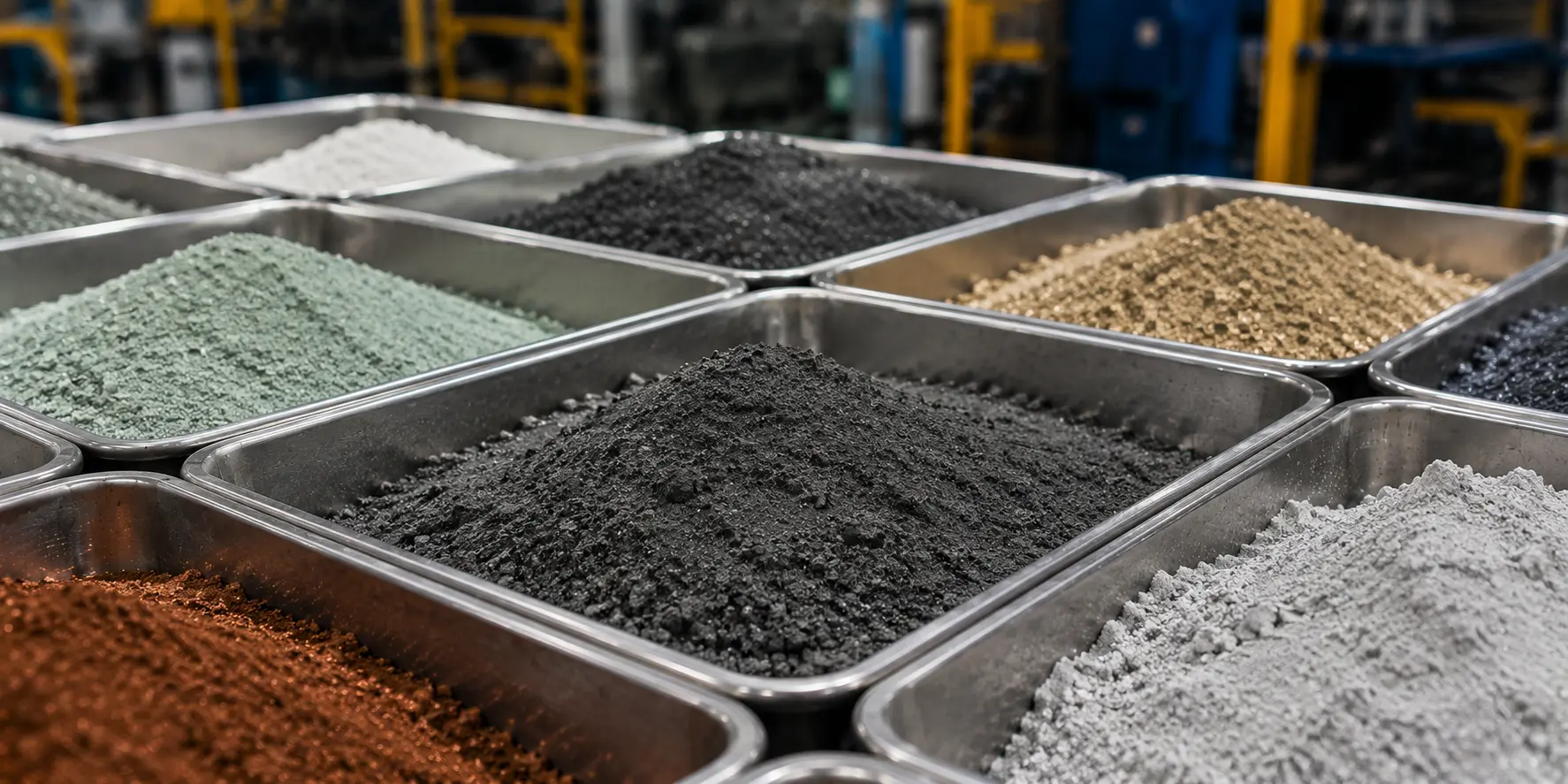
Each mineral recovered through Blackgold’s processes represents a reduction in primary extraction demand and a strengthening of domestic industrial supply chains.

Lithium

Battery electrolytes, cathodes, and energy storage systems

Battery-grade recovery

Cobalt

NMC and NCA cathode materials — highest economic value per kg

High market value

Nickel

High-nickel cathodes — critical for next-generation battery density

Reintegration ready

Rare Earths

Magnets, motors, display systems, and precision electronics
Strategically critical

Continuity Over Extraction

A Different Set of Priorities

Traditional models optimize for throughput — how much can be extracted. Emerging models optimize for continuity — how long materials remain usable within the system. This shift introduces a fundamentally different set of priorities.

Traditional Model — Optimize for Throughput

Emerging Model — Optimize for Continuity

Material Retention

Designing systems that keep critical minerals in active circulation — maximizing the productive lifespan of each unit of material extracted from the earth.

System Design

Building interconnected processes — collection, processing, recovery, reintegration — that function as a coherent system rather than a set of isolated operations.

Lifecycle Visibility

Maintaining traceability across the material lifecycle — from original manufacture through recovery and reintegration — enabling informed industrial decision-making.

A System, Not a Stream

Effective Recovery Is a System-Layer Intervention

Critical mineral recovery is often approached as a downstream activity — something that happens after value has been extracted. In reality, it is a system-layer intervention that must be designed in from the start.

Without alignment across all four layers, material is lost — not due to scarcity, but due to system inefficiency. Blackgold is building that alignment.

Product Design

Materials are designed for disassembly and recovery — not disposal — enabling efficient downstream extraction.

Collection Mechanisms

Structured aggregation channels that capture end-of-life products before they enter informal or landfill streams.

Processing Capabilities

Industrial-scale infrastructure for safe, efficient, and chemistry-specific material separation and extraction.

End-Market Reintegration

Recovered materials fed directly into manufacturing supply chains — closing the loop between recovery and production.

Without this alignment, material is lost – not due to scarcity, but due to system inefficiency. The gap is not geological. It is infrastructural. And it is solvable.

FAQ

Common Questions

Key questions on critical minerals,
secondary extraction, and how Black
Gold approaches this strategic vertical.

1. Why should manufacturers care about where their critical minerals come from?

Lithium, cobalt, nickel, and rare earths are concentrated in a handful of geographies, which creates real exposure for any business that depends on them. Diversifying supply toward recovered materials gives manufacturers a way to reduce that concentration risk instead of staying fully dependent on primary mining regions.

Every battery pack, server, and smartphone that reaches end-of-life carries recoverable quantities of lithium, cobalt, nickel, and rare earth elements within it. As more first-generation electronics and EVs retire, this pool of embedded material keeps expanding, forming a supply source that grows alongside consumption rather than depleting like a mine.

It’s less an alternative and more a parallel supply channel. Recovered materials from electronics and batteries often exist at higher concentrations than the ores they originally came from, and they’re located closer to consumption centers, which can mean shorter, less complex supply chains for manufacturers.

BlackGold’s critical mineral recovery process is built to a 99.2% purity standard, meeting battery-grade and industrial-grade supply chain specifications. The process currently recovers lithium, cobalt, nickel, and rare earth elements, operating under CPCB hazardous material authorizations and EPR framework alignment, with an end-to-end system spanning aggregation through reintegration under one operational framework.

Primary mining capacity can take over a decade to come online, so it can’t respond quickly to demand spikes. Recovered materials from circulation offer a supply layer that isn’t bound by those long development cycles, giving procurement teams an additional buffer against primary market volatility.

When products are engineered for disassembly rather than disposal, the critical minerals inside them stay accessible for future recovery instead of being lost in landfill. This kind of design decision upstream directly determines how much value can realistically be recaptured once a product reaches end-of-life.

Recovered lithium, cobalt, nickel, and rare earths are processed and fed back into manufacturing supply chains rather than treated as isolated byproducts. This reintegration step is what closes the loop, turning end-of-life electronics and batteries into an ongoing input for new production rather than a one-time recovery event.

Explore More

Related Verticals

Li-Ion Battery Recycling

Safe collection, processing, and hydrometallurgical recovery of lithium-ion battery packs from EVs, consumer electronics, and storage systems.

Electronics Refurbishment

Certified testing, grading, and restoration of functional electronics — returning assets to economic life with documented performance grades.

E-Waste Recycling

End-to-end processing of consumer and industrial electronics with certified material recovery, full audit documentation, and chain-of-custody traceability.

Work With Us

Recover What Others Are Losing

Whether you generate battery waste, electronic scrap, or manufacturing residues — Blackgold provides the integrated, compliant, and scalable system to recover the critical minerals
embedded within your waste streams.

99.2% purity standard — recovered minerals meet battery- grade and industrial-grade supply chain specifications.

4 critical minerals recovered — lithium, cobalt, nickel, and rare earth elements reintegrated into supply chains.

Full regulatory compliance — CPCB hazardous material authorizations and EPR framework alignment across all recovery operations.

End-to-end system — aggregation through reintegration, managed under one integrated operational framework with full traceability.